This lecture is intended as a supplementary resource for clinicians and trainees to review evidence and discuss clinical cases.
What this primer is for
A positive culture tells us which organism grew. It does not establish that the organism is causing infection, that a drug reaches the infected tissue, or that antibiotics alone will clear the source.
The cases follow an antibiotic decision from the first dose to reassessment. The initial choice reflects the syndrome and severity of illness. As cultures return and the clinical course becomes clearer, the question shifts to whether the patient still needs the same drug, route, or duration.
By the end, you should be able to
- Build an empiric regimen from the syndrome, severity, likely pathogens, prior microbiology, and local resistance data.
- Compare the practical coverage gaps of commonly used inpatient antibiotics, recognize the major restricted agents, and know when their use requires ID and pharmacy input.
- Recognize when dose, route, tissue penetration, toxicity, monitoring needs, or source control makes an apparently active drug a poor choice.
- Narrow, stop, or transition therapy when the clinical and microbiologic data permit.
- Explain what the major antibiotic trials did and did not establish.
Local information. The local antibiogram describes a population; the susceptibility report describes the patient’s isolate. The formulary, renal dosing resources, and vancomycin monitoring service supply practical details that a lecture cannot.
This is primarily a resident primer. Residents should complete the main text. Fellows should know the same material and continue through the brief
fellow section on resistance mechanisms, difficult treatment choices, and pipeline agents.
Before choosing the drug
The first decision is whether the patient has an infection and how urgently it needs treatment. An unstable patient may need broad initial coverage. In a stable patient, a better specimen may clarify whether antibiotics are needed at all. When an infected space needs drainage, broadening coverage does not resolve the underlying problem.
Is there an infection?What findings support infection rather than colonization, inflammation, aspiration pneumonitis, or a contaminated specimen?
How sick is the patient?Instability lowers the tolerance for missing a pathogen. A stable patient allows more diagnostic precision.
Where is it?The syndrome determines likely organisms, penetration, source control, and duration.
What has grown before?Prior cultures, recent antibiotics, devices, healthcare exposures, and local resistance patterns help estimate which organisms may be present.
What will fix the source?Drainage, debridement, device removal, or relief of obstruction may matter more than adding another drug.
When will we reassess?Which results are likely in the next 24–72 hours? What would support narrower therapy or show that antibiotics are unnecessary?
For students and residents
Be able to state the syndrome, likely organisms, why the chosen drug covers them, what it misses, and what information will change the plan.
For fellows
Separate guideline recommendations from trial evidence and local practice. When several drugs are active, weigh resistance mechanism, inoculum, exposure, toxicity, source control, and the consequences of failure.
A practical word about dosing
Dose depends on what exposure is needed at the site of infection and how the patient clears the drug. Cystitis, bacteremia, and meningitis need not share a regimen. Obesity, augmented renal clearance, and intermittent or continuous dialysis add further variability. Loading and maintenance doses are separate questions for the drug-specific reference and pharmacy team. In severe infection, dose verification belongs before the first administration rather than on the next day’s rounds.
Infusion practice. The choice between standard and extended beta-lactam infusions depends on the drug, indication, and local protocol. The current institutional order set and pharmacy guidance describe how each regimen is delivered.
Beta-lactams
Spectrum tables describe which organisms a drug can inhibit. Whether it will treat an infection also depends on the resistance mechanism, the exposure achievable at that site, and the clinical evidence for the drug.1
Common inpatient beta-lactams
| Drug | Where it is commonly useful | Important gaps and cautions |
|---|
| Ampicillin or amoxicillin | Susceptible streptococci, Enterococcus faecalis, and Listeria. | Klebsiella pneumoniae is intrinsically resistant to ampicillin. Activity against E. coli is too variable for routine empiric use.12 |
| Ampicillin-sulbactam | Streptococci, MSSA, susceptible E. faecalis, oral flora, and anaerobes. Commonly used for selected head and neck, aspiration-related, skin, and polymicrobial infections. | No Pseudomonas. Empiric E. coli and Klebsiella reliability depends on local susceptibility. CRAB dosing is a separate specialist use. |
| Piperacillin-tazobactam | Broad empiric coverage including susceptible E. coli, Klebsiella, Pseudomonas, anaerobes, streptococci, MSSA, and many E. faecalis isolates. | No MRSA activity. ESBL and AmpC mechanisms limit reliability. For ESBL bloodstream infection, a susceptible report alone does not make piperacillin-tazobactam preferred definitive therapy.1 |
| Cefazolin | MSSA, streptococci, and susceptible E. coli, Klebsiella, and Proteus mirabilis. Often preferred for MSSA infection. | No enterococci, MRSA, or Pseudomonas. Not a treatment for ESBL-producing isolates. Use systemic cefazolin breakpoints for invasive Enterobacterales infection. The CLSI urine-only cefazolin surrogate for oral cephalosporins applies to selected organisms in uncomplicated cystitis.43 |
| Ceftriaxone | Most streptococci, most pneumococci, and many susceptible Enterobacterales, including E. coli and Klebsiella. Useful for many community-onset infections. | No Pseudomonas, enterococci, or MRSA. Avoid as definitive therapy for invasive infection due to organisms at moderate risk of inducible AmpC, including Enterobacter cloacae complex, Klebsiella aerogenes, Citrobacter freundii, and Hafnia alvei.1 |
| Cefepime | Susceptible Enterobacterales, including E. coli and Klebsiella, Pseudomonas, MSSA, and streptococci. Relatively stable against AmpC. | No dependable anaerobic, enterococcal, or MRSA coverage. New encephalopathy, myoclonus, aphasia, or seizures warrant prompt assessment for cefepime neurotoxicity, even after renal adjustment. If cefepime neurotoxicity occurs, discontinue cefepime, provide supportive care, and assess alternative active coverage.42 |
| Ertapenem | ESBL-producing E. coli or Klebsiella, susceptible mixed Enterobacterales, and anaerobes when a carbapenem is indicated. | No reliable Pseudomonas, Acinetobacter, enterococcal, or MRSA activity. Critical illness or hypoalbuminemia makes ertapenem exposure less predictable; meropenem or imipenem-cilastatin is preferred in that setting for invasive ESBL infection.1 |
| Meropenem | Serious ESBL infection, many susceptible Enterobacterales, Pseudomonas, and anaerobes. | No MRSA and unreliable enterococcal activity. Preserve for situations where its spectrum or resistance stability is needed. |
| Aztreonam | Targeted aerobic gram-negative coverage, including susceptible Pseudomonas, when preferred beta-lactams cannot be used. | No gram-positive or anaerobic activity and unreliable empiric coverage for many resistant gram-negative organisms. It is usually a poor empiric monotherapy choice for a seriously ill patient. It usually has very low cross-reactivity with other beta-lactams, but it shares an identical R1 side chain with ceftazidime. A convincing immediate or severe ceftazidime allergy should prompt allergy-guided review rather than routine aztreonam use.421 |
Ceftaroline and ceftobiprole
Where ceftaroline and ceftobiprole fit
| Drug | What makes it different | What residents should not assume |
|---|
Ceftaroline
Teflaro | A cephalosporin with MRSA activity. FDA-labeled uses are acute bacterial skin and skin-structure infection, including MRSA, and community-acquired bacterial pneumonia due to designated susceptible organisms. The pneumonia indication includes MSSA, not MRSA.22 | MRSA bacteremia and endocarditis use is off-label and is supported mainly by observational salvage and combination-therapy experience, not a definitive randomized bacteremia trial. Do not count on Pseudomonas, enterococci, atypical organisms, or clinically adequate anaerobic coverage. |
Ceftobiprole
Zevtera | A cephalosporin with activity against MSSA and MRSA. FDA-labeled uses include adult S. aureus bacteremia, including right-sided endocarditis, adult acute bacterial skin and skin-structure infection, and community-acquired bacterial pneumonia in adults and children at least 3 months old. For S. aureus, the pneumonia indication covers susceptible MSSA.23 | For endocarditis, the labeled indication is right-sided. Hospital-acquired and ventilator-associated pneumonia are outside the U.S. indication. The label reports higher mortality in a ventilator-associated pneumonia trial subgroup.23 It is not a dependable choice for Pseudomonas, ESBL-producing Enterobacterales, anaerobes, or atypical pneumonia pathogens. Confirm formulary status and susceptibility before use. |
ERADICATE provides randomized trial data for ceftobiprole in complicated
S. aureus bacteremia. Ceftobiprole was noninferior to daptomycin for overall treatment success: 69.8% compared with 68.7%. The adjusted difference was 2.0 percentage points, with a 95% confidence interval from −7.1 to 11.1. Ceftaroline does not have comparable randomized trial evidence for MRSA bacteremia. ERADICATE also should not be extrapolated to every endovascular infection.
24Consider
Klebsiella coverage separately from
E. coli. Susceptible isolates may be covered by cefazolin, ceftriaxone, cefepime, piperacillin-tazobactam, or a carbapenem, depending on the syndrome and susceptibility result. Ampicillin is not active against
K. pneumoniae. A carbapenem is generally preferred for invasive ESBL-producing
K. pneumoniae infection.
112Resident essential: ESBL and AmpC are not interchangeable labels
ESBL enzymes inactivate most penicillins, cephalosporins, and aztreonam. They are frequently encountered in E. coli, K. pneumoniae, and K. oxytoca; carbapenems generally retain activity. Inducible AmpC presents a different problem: an initially susceptible isolate can develop resistance during ceftriaxone exposure. E. cloacae complex, K. aerogenes, and C. freundii carry moderate risk. H. alvei is grouped with them largely on in vitro evidence; clinical experience is limited.1
For these moderate-risk species, cefepime is a preferred option when its MIC falls in the susceptible or susceptible-dose-dependent range, no ESBL gene has been identified, and the regimen provides the exposure that MIC requires. Ceftriaxone is generally unsuitable as planned therapy for invasive infection. A narrower exception is completion of empiric ceftriaxone for selected nonsevere infections after improvement and adequate source control. Y. enterocolitica also has inducible chromosomal ampC, but clinical evidence is insufficient to assign it the same risk; the isolate’s susceptibility and the syndrome matter.1
Approach to a reported penicillin allergy
Penicillin allergy assessment, testing, and side-chain cross-reactivity
A reaction history defines the clinical question; the local allergy pathway determines how testing or a supervised challenge is performed.
An allergy history has a chronology: which drug was given, how soon symptoms appeared, what treatment was needed, how long ago the reaction occurred, and which beta-lactams the patient has tolerated since. Many reported penicillin allergies do not represent current IgE-mediated allergy. Missing details leave the history unresolved.4
Classify the reaction before choosing another beta-lactam
| History | Typical features | Interpretation |
|---|
| Intolerance or nonallergic history | Isolated nausea, diarrhea, headache, family history, or a label entered without a patient reaction. | These findings alone do not establish immune-mediated allergy. The record is more useful when it describes the actual symptoms. |
| Possible immediate IgE-mediated reaction | Urticaria, angioedema, bronchospasm, hypotension, or anaphylaxis beginning within minutes to several hours. | The timing and culprit drug help distinguish an immediate reaction. Side-chain relationships and the local allergy pathway inform the choice of an alternative. |
| Benign delayed eruption | Morbilliform or maculopapular rash appearing after several days, without mucosal lesions, blistering, systemic illness, or organ injury. | The course of the rash and subsequent tolerance help identify patients eligible for supervised challenge under the local pathway. |
| Severe delayed or organ-specific reaction | SJS/TEN, DRESS, AGEP, interstitial nephritis, drug-induced liver injury, serum sickness, hemolytic anemia, or immune thrombocytopenia. | Do not use PEN-FAST to clear the allergy or proceed to routine challenge. Avoid the culprit and obtain Allergy/Immunology or specialist guidance. |
PEN-FAST
Scoring
- F: reaction within 5 years, or timing unknown: 2 points
- A or S: anaphylaxis or angioedema, or a severe cutaneous adverse reaction: 2 points
- T: treatment required, or treatment unknown: 1 point
Derivation-cohort risk estimates
- 0: very low risk, less than 1%
- 1–2: low risk, about 5%
- 3: moderate risk, about 20%
- 4–5: high risk, about 50%
What a low PEN-FAST score means. A score below 3 had a negative predictive value of 96.3% in the original Melbourne derivation/internal-validation cohort; external-cohort values ranged from 84.9% to 98.4%. These estimates depend on the tested population. Isolated drug fever, serum sickness, interstitial nephritis and drug-induced liver injury were excluded phenotypes, so a low score does not clear those histories.
13 The
PEN-FAST calculator can help organize the history. For delabeling, test doses, and oral challenges, residents work with the supervising team and follow the local pathway. Suspected severe delayed reactions follow a separate pathway.
Testing, challenge, and desensitization
Skin testing
Immediate-reading penicillin skin testing assesses IgE sensitization. An observed oral amoxicillin challenge usually follows a negative test when the history is appropriate for challenge. Severe delayed skin reactions and drug-related organ or blood-cell injury require a separate specialist assessment.4
When to involve Allergy/Immunology
Allergy evaluation is especially useful when the label rules out a clearly preferable drug, when several allergy labels limit treatment, or when transplant, chemotherapy, or another immunocompromising condition makes repeated antibiotic exposure likely.
Graded challenge
A graded challenge assesses whether a low-risk patient tolerates the drug. It does not induce temporary tolerance. The eligibility and supervision for a challenge depend on the clinical setting and the evaluating team.
Desensitization
Desensitization induces temporary tolerance when the preferred drug is required and an appropriate alternative is not available. It requires a supervised protocol and uninterrupted dosing. It is not a routine approach to severe delayed reactions.
Cross-reactivity
R1 side-chain similarity helps explain why a penicillin allergy does not predict a reaction to every cephalosporin. An unverified, nonanaphylactic penicillin allergy without features of a severe delayed reaction generally does not require testing or added precautions before a cephalosporin. After penicillin anaphylaxis, the 2022 practice parameter conditionally supports a cephalosporin with a dissimilar R1 side chain, such as cefazolin, without pretesting or added precautions. Prior anaphylaxis to a cephalosporin follows a separate testing pathway. Cross-reactivity with carbapenems is also low. Routine pretesting or added precautions are generally unnecessary for immediate penicillin or cephalosporin allergy, including anaphylaxis. Severe delayed skin reactions and drug-related organ or blood-cell injury call for specialist review.4
Side-chain relationships worth remembering
| Index allergy | Higher-concern related drug | Clinical significance |
|---|
| Amoxicillin | Cefadroxil | These share the same R1 side chain. A convincing immediate amoxicillin reaction deserves specific review before cefadroxil is used. |
| Ampicillin | Cephalexin and cefaclor | Cephalexin and cefaclor share ampicillin’s R1 side chain. Do not treat an ampicillin allergy label as a class-wide cephalosporin ban, but do not ignore the phenotype when choosing one of these drugs. |
| Ceftazidime | Aztreonam | These share an identical R1 side chain. A convincing immediate or severe ceftazidime reaction should prompt allergy-guided review before aztreonam. |
| Cefazolin | No commonly used beta-lactam shares its R1 side chain | An isolated cefazolin allergy does not automatically predict a reaction to penicillins or other cephalosporins. Prior cephalosporin anaphylaxis calls for the separate cephalosporin testing pathway before a parenteral cephalosporin with a nonidentical R1 side chain. |
The bedside table above lists the relationships most likely to change a resident's immediate decision. The penicillin allergy module shows selected R1 relationships and their limits. Northwestern Medicine’s public chart is a separate reference that includes R1 and R2 information.43541
Newer and restricted gram-negative agents
Newer gram-negative agents differ in which resistance mechanisms they overcome and which organisms they still miss. In a discussion with ID or pharmacy, the useful starting points are the isolate, infection site, full susceptibility report, prior therapy, and source control. Restrictions vary by institution.1
What residents should recognize on the medication list
| Agent | Why it may be used | What to remember |
|---|
Ceftazidime-avibactam
Avycaz | Selected carbapenem-resistant Enterobacterales and some resistant Pseudomonas. | It does not cover every resistance mechanism and is not reliable alone for NDM. It also lacks dependable anaerobic, MRSA, and enterococcal coverage. |
Ceftolozane-tazobactam
Zerbaxa | Primarily susceptible, highly resistant Pseudomonas. | It is not the default drug for carbapenem-resistant Enterobacterales and is not a complete regimen for a polymicrobial infection. |
Meropenem-vaborbactam
Vabomere32
Imipenem-cilastatin-relebactam
Recarbrio33 | Selected carbapenem-resistant Enterobacterales. IDSA also includes imipenem-cilastatin-relebactam as an option for susceptible DTR Pseudomonas.1 | Vaborbactam adds little activity against the usual resistance mechanisms in DTR Pseudomonas; relebactam can restore imipenem activity in some isolates. The isolate’s susceptibility helps distinguish their roles. |
Cefiderocol
Fetroja | Selected infections caused by highly resistant aerobic gram-negative organisms. | It has no useful gram-positive or anaerobic activity, and susceptibility is not universal. |
Aztreonam-avibactam
Emblaveo
or ceftazidime-avibactam plus aztreonam | Selected NDM-producing Enterobacterales. Other metallo-beta-lactamases require organism-specific review. | These are specialist regimens. They do not provide dependable gram-positive or anaerobic coverage. Aztreonam alone is not an adequate substitute. |
Sulbactam-durlobactam
Xacduro | Carbapenem-resistant Acinetobacter baumannii, usually with imipenem-cilastatin or meropenem.134 | Its role is specific to resistant Acinetobacter. It is not a CRE or resistant Pseudomonas drug. |
Why not meropenem-vaborbactam for DTR Pseudomonas? Vaborbactam primarily inhibits class A enzymes, especially KPC, but does not correct OprD porin loss, increased efflux, or metallo-beta-lactamase production, important causes of carbapenem resistance in
P. aeruginosa. It generally provides little additional activity over meropenem against this organism. For DTR
Pseudomonas, use the infection site and isolate susceptibility to choose among newer agents. Cefiderocol is a preferred option for complicated UTI and for metallo-beta-lactamase producers when active. See the
fellow discussion of site and carbapenemase exceptions. The drug class alone does not predict activity.
1
Resident expectation: explain the organism, infection site, susceptibility results, source-control status, and why a restricted drug is being considered. Selection, dosing, and enzyme-level matching should be reviewed with ID pharmacy or an experienced ID consultant. Residents may continue to
other commonly used inpatient agents; the next section is optional fellow detail.
Optional fellow detail
Choosing among restricted gram-negative agents
Carbapenemase-specific treatment · Species-specific resistance and exceptions
Two drugs may both test active yet differ in clinical evidence, exposure at the infection site, or vulnerability to an enzyme the isolate produces. Those differences, along with prior drug exposure and the local formulary, shape the discussion with microbiology and stewardship.
Drug-specific selection and limitations
| Agent | Where it may fit | Main limitation |
|---|
Ceftazidime-avibactam
Avycaz | A preferred option for KPC-producing Enterobacterales and the preferred option for OXA-48-like Enterobacterales. It is also one option for susceptible difficult-to-treat resistant Pseudomonas.114 | Avibactam does not inhibit metallo-beta-lactamases such as NDM, VIM, or IMP. Ceftazidime-avibactam alone should not be assumed active against an NDM-producing isolate. |
Ceftolozane-tazobactam
Zerbaxa | Its main niche is susceptible difficult-to-treat resistant Pseudomonas aeruginosa. It is preferred for DTR Pseudomonas pneumonia when susceptible and neither KPC nor an MBL has been identified. It also has ESBL activity, but broader reserve agents are generally preserved when a carbapenem or an active oral drug is adequate.115 | It is not a dependable solution for carbapenemase-producing Enterobacterales, and susceptibility should not be inferred from the organism name. |
Cefiderocol
Fetroja | A siderophore cephalosporin with activity against some highly resistant Enterobacterales and nonfermenters. It is among the preferred options for NDM-producing Enterobacterales and metallo-beta-lactamase-producing Pseudomonas. Its role differs in CRAB and invasive Stenotrophomonas maltophilia infection.116 | Activity is not universal, and clinical evidence remains limited for several of these organisms. The label retains a warning about an observed mortality imbalance in a trial involving carbapenem-resistant gram-negative infections. Confirm susceptibility before use. |
| Aztreonam | A traditional monobactam active only against susceptible aerobic gram-negative organisms, including some Pseudomonas. It is stable to hydrolysis by metallo-beta-lactamases, which becomes useful when paired with an inhibitor that blocks commonly co-produced serine beta-lactamases. | Aztreonam alone is often hydrolyzed by ESBL, AmpC, KPC, or OXA enzymes that travel with NDM and other MBLs. It is not a reliable MBL regimen by itself and is usually a poor empiric agent because it has no gram-positive or anaerobic activity and gram-negative susceptibility cannot be assumed. Penicillin allergy alone generally does not preclude aztreonam. Ceftazidime shares an identical R1 side chain, and clinical cross-reactivity has been reported. With a convincing immediate or severe ceftazidime reaction, clarify the phenotype and follow the local allergy pathway before using aztreonam.421 |
Aztreonam-avibactam
Emblaveo | The fixed combination protects aztreonam from many co-produced serine beta-lactamases. For invasive NDM-producing Enterobacterales infection, IDSA lists aztreonam-avibactam and cefiderocol as preferred options when active. When the fixed formulation is unavailable, ceftazidime-avibactam plus aztreonam is an alternative. IDSA favors the fixed formulation over separate infusions because it synchronizes drug exposure and is simpler to administer. There are no direct clinical comparisons between aztreonam-avibactam and cefiderocol. FDA labeling is narrower: adults with complicated intra-abdominal infection, given with metronidazole, who have limited or no alternatives.117 | It has limited activity against MBL-producing Pseudomonas, and there are no FDA or CLSI breakpoints for that organism. Several mechanism-based uses in IDSA guidance extend beyond the FDA indication. |
| Ceftazidime-avibactam plus aztreonam | An alternative for NDM-producing Enterobacterales when the fixed aztreonam-avibactam product is not available. Avibactam protects aztreonam from the accompanying serine beta-lactamases while aztreonam avoids hydrolysis by NDM.1 | The combination requires coordinated dosing, renal adjustment, microbiology support, and ID pharmacy review. |
Coverage gaps with newer gram-negative agents
Adding an inhibitor to a beta-lactam can restore activity against a resistant gram-negative isolate. That activity does not imply coverage of anaerobes, MRSA, enterococci, or atypical organisms. Sulbactam is a useful exception to the usual role of the inhibitor because it also acts directly against A. baumannii.1
Coverage gaps in mixed infections
| Agent | Anaerobes | Gram-positive organisms | Clinical implication |
|---|
Ceftazidime-avibactam
Avycaz | Anaerobic activity is insufficient for its labeled complicated intra-abdominal infection regimen, which includes metronidazole.14 | Unreliable against MRSA and enterococci. | Its activity against a resistant gram-negative isolate covers only part of a mixed infection. |
Ceftolozane-tazobactam
Zerbaxa | Its labeled regimen for complicated intra-abdominal infection includes metronidazole for anaerobic coverage.15 | Unreliable against MRSA and enterococci. | Its primary role is treatment of susceptible resistant Pseudomonas. |
Cefiderocol
Fetroja | Targets aerobic gram-negative organisms and leaves anaerobes uncovered.16 | No dependable gram-positive coverage. | A susceptible gram-negative result does not make it a complete regimen for a mixed infection in which gram-positive or anaerobic pathogens also require treatment. |
| Aztreonam | No clinically useful anaerobic activity. | No clinically useful gram-positive activity. | Its activity is limited to susceptible aerobic gram-negative organisms. Alone, it may fail against an NDM isolate when ESBL, AmpC, KPC, or OXA enzymes are also present. Aztreonam and ceftazidime share an identical R1 side chain, so a ceftazidime allergy requires review.21 |
Aztreonam-avibactam
Emblaveo | Its labeled regimen for complicated intra-abdominal infection requires metronidazole for anaerobic coverage.17 | No dependable gram-positive coverage. | The U.S. indication applies to adults with limited or no alternatives.17 |
| Ceftazidime-avibactam plus aztreonam | The combination does not supply dependable anaerobic coverage. | The combination does not supply dependable MRSA or enterococcal coverage. | Whether these gaps matter depends on which pathogens are implicated at the infection site. |
A coverage gap matters when the missing pathogen is plausible at the infection site. Drainage or debridement, culture results, and the clinical response may change how much coverage is still needed.
Using the resistance mechanism to choose among active agents
A resistance mechanism narrows the list of plausible drugs. The measured susceptibility, infection site, prior exposure, and clinical evidence distinguish among them. A mismatch between the expected and reported activity is a useful question for microbiology or stewardship.
Why resistance mechanisms change drug choice
| Resistance problem | Agents to discuss | Main caution |
|---|
| KPC-producing Enterobacterales | For invasive infection, IDSA considers meropenem-vaborbactam, ceftazidime-avibactam, and imipenem-relebactam preferred options and slightly favors them in that order.1 | Site, susceptibility, prior exposure, and availability guide selection. The ranking draws on observational evidence. |
| OXA-48-like Enterobacterales | Ceftazidime-avibactam | Meropenem-vaborbactam and imipenem-relebactam are not reliable OXA-48 solutions. |
| NDM or another MBL in Enterobacterales | Aztreonam-avibactam or cefiderocol. Ceftazidime-avibactam plus aztreonam is an alternative when the fixed product is unavailable. | Ceftazidime-avibactam alone does not inhibit the MBL. |
| DTR Pseudomonas aeruginosa, complicated UTI | Preferred if active: cefiderocol, ceftazidime-avibactam, ceftolozane-tazobactam, or imipenem-relebactam.1 | Use the mechanism-specific rows below if a carbapenemase is identified. |
| DTR P. aeruginosa, nonurinary infection without an identified carbapenemase | Preferred if active: ceftolozane-tazobactam, ceftazidime-avibactam, or imipenem-relebactam. Cefiderocol is an alternative.1 | Ceftolozane-tazobactam is preferred for pneumonia when susceptible and neither KPC nor an MBL is identified. |
| KPC-producing P. aeruginosa | Preferred if active: cefiderocol, ceftazidime-avibactam, or imipenem-relebactam.1 | Tazobactam does not inhibit KPC. Use agent-specific susceptibility results. |
| MBL-producing P. aeruginosa (NDM, VIM, IMP) | Cefiderocol is preferred if active.1 | The NDM-producing Enterobacterales recommendations do not transfer to this organism. |
| CRAB | A sulbactam-containing regimen, preferably sulbactam-durlobactam in current guidance | The treatment evidence for CRAB differs from that for CRE or DTR Pseudomonas. |
The table summarizes expert guidance. An enzyme name alone does not establish clinical activity; isolate testing, site, source control, and drug availability remain relevant.1
Newer oral options and pipeline evidence
For ESBL complicated UTI today, TMP-SMX, ciprofloxacin, or levofloxacin remain preferred oral options when susceptibility is demonstrated and the patient is otherwise appropriate for oral therapy.1 The newer oral drugs below do not create a general oral pathway for ESBL bacteremia or infection outside the urinary tract.
Access matters: confirm inpatient formulary status and outpatient availability before building a transition plan around a newer oral agent.
Approved oral agents: labeling details
Tebipenem pivoxil (Utebzi) was FDA-approved in June 2026 as the first oral carbapenem in the United States. Its indication is complicated UTI, including pyelonephritis, caused by listed susceptible organisms in adults with limited or no alternative oral options. Approval does not establish it for nonurinary ESBL infection, endovascular infection, or an uncontrolled urinary source.18 In June 2026, GSK anticipated U.S. availability by year-end.44
Sulopenem etzadroxil-probenecid (Orlynvah) is FDA-approved for selected adult women with uncomplicated UTI; its label excludes primary or step-down treatment of cUTI.19 After improvement on IV therapy, oral sulopenem has a limited, off-label role as an alternative for selected ESBL-E cUTI. This evidence does not extend to nonurinary bacteremia.1
Investigational oral agent
Ceftibuten-ledaborbactam etzadroxil pairs an oral cephalosporin with an oral prodrug of a boronic-acid beta-lactamase inhibitor. In vitro studies show activity against many ESBL-, AmpC-, KPC-, and OXA-48-producing Enterobacterales. In October 2026, the developer reported plans for a phase 2/3 cUTI study with a mid-2027 target start. It remains investigational and has no clinical outcomes establishing its role in cUTI.20
Recheck approval status, labeling, availability, outcome data, and the local susceptibility-testing method before considering a pipeline agent. In vitro activity alone is insufficient.
Other commonly used inpatient agents
Vancomycin
Vancomycin provides empiric coverage for serious suspected MRSA infection and selected resistant gram-positive infections. Its exposure varies with renal function, so the timing of blood samples affects their interpretation.
For serious MRSA infection, the monitoring target is an AUC24 of 400–600 mg·h/L when the MIC is assumed to be 1 mg/L. A trough alone, even one between 15 and 20 mg/L, is not the recommended target for that indication. The treating pharmacy or OPAT service coordinates sampling and interpretation.3
Daptomycin
FDA-labeled for S. aureus bacteremia, including right-sided endocarditis in adults, and selected skin infections. VRE treatment is off-label and requires specialist selection. It should not be used for pneumonia. CPK trends, renal function, statin exposure, and new muscle symptoms inform safety monitoring. Dose selection depends on organism and syndrome.25
Linezolid
Linezolid has similar oral and IV exposure and activity against MRSA in pneumonia and selected VRE infections. Blood counts, serotonergic drug interactions, and neuropathy risk become important during treatment.26
TMP-SMX
TMP-SMX has a role in susceptible urinary infections, MRSA skin infection, and selected organism-specific indications. Doses are expressed by the trimethoprim component. Potassium, renal function, blood counts, and interacting medications affect its suitability.27
Metronidazole
Provides anaerobic coverage below the diaphragm and for selected oral anaerobic infections. Adding it to piperacillin-tazobactam or a carbapenem is usually redundant.
Nitrofurantoin
Nitrofurantoin is a lower-tract drug. It should not be used for pyelonephritis or bacteremia.
Oral fosfomycin
Oral fosfomycin has a single-dose U.S. indication for uncomplicated cystitis in adult women with susceptible E. coli or E. faecalis. Pyelonephritis and perinephric abscess fall outside that indication.40
Two newer oral UTI drugs residents may hear about. Tebipenem pivoxil (Utebzi) is approved for selected adults with complicated UTI, including pyelonephritis, who have limited or no alternative oral options. Sulopenem etzadroxil-probenecid (Orlynvah) is labeled for selected adult women with uncomplicated UTI; its label excludes cUTI. Switching to oral sulopenem after improvement on IV therapy is a selected, off-label alternative for ESBL-E cUTI.
1 Hospital and outpatient availability may limit the use of either drug.
1819
Where oral fosfomycin may fit
Oral fosfomycin on the inpatient service
| Clinical question | Practical interpretation |
|---|
| Uncomplicated cystitis | The U.S. oral fosfomycin label specifies a single dose for acute uncomplicated cystitis in adult women with susceptible E. coli or E. faecalis. The indication does not include pyelonephritis or perinephric abscess.40 |
| Pyelonephritis or complicated UTI | Oral fosfomycin has limited exposure in renal tissue. Evidence for initial treatment of pyelonephritis with oral fosfomycin is insufficient.139 In the 2026 trial by Seo et al., hospitalized adults with complicated UTI due to ESBL-producing Enterobacterales were randomized after improving on 3 to 7 days of IV antibiotics. Clinical cure was 92.8% after switching to oral fosfomycin and 95.2% with continued IV beta-lactam therapy. The trial used 3 g once daily as an off-label transition regimen and was published after the March 2026 IDSA AMR evidence cutoff. The trial did not test a single oral dose or initial oral treatment of pyelonephritis.37 The suggested clinical role is narrower than the trial population: selected ESBL-producing E. coli cUTI after improvement on initial therapy, with adequate source control and follow-up, when other oral options are unavailable.1 |
| ESBL bloodstream infection | Low serum exposure and limited clinical data argue against routine oral fosfomycin step-down for ESBL bloodstream infection. When an active fluoroquinolone or TMP-SMX is available and appropriate, those are better-supported oral options.1 |
| Klebsiella or another non-E. coli gram-negative organism | Among gram-negative organisms, oral fosfomycin’s supported role is limited to E. coli. Other organisms, including K. pneumoniae, commonly carry fosA genes that may compromise activity. Limited oral susceptibility criteria make an isolated urine result difficult to interpret.1 |
When standard treatment cannot be completed. Inability to arrange IV treatment warrants urgent ID, pharmacy and care-coordination review of active treatment and delivery options. The cUTI transition evidence above does not establish oral fosfomycin as completion therapy for ESBL bloodstream infection, even after blood cultures clear. Any exceptional treatment plan requires an explicit account of the remaining infection, expected drug exposure, source control, uncertainty and follow-up.
1
Fluoroquinolones
For cUTI that is improving on effective therapy, IDSA conditionally suggests 5–7 days of an active fluoroquinolone or 7 days of an active non-fluoroquinolone, counted from the first day of effective therapy. Certainty is moderate for fluoroquinolones and very low for other agents. Patients with delayed improvement need reassessment for an uncontrolled source or another reason for treatment failure. The separate conditional duration for improving cUTI with gram-negative bacteremia is 7 days. The case below illustrates how response and relief of obstruction affect those decisions.2
Oral treatment of susceptible Pseudomonas. Ciprofloxacin and levofloxacin are oral options when the isolate is susceptible. Moxifloxacin should not be used for a urinary infection and is not a dependable antipseudomonal drug. Activity cannot be inferred from the species name, and resistance can emerge during treatment.
16
The convenience of oral treatment must be weighed against fluoroquinolone toxicity. FDA warnings address disabling tendon, muscle, joint, peripheral nerve, and CNS effects, dysglycemia, and aortic aneurysm or dissection in susceptible patients. QT risk, renal function, interacting drugs, and reduced absorption with cations or tube feeds can change the choice.5
Laboratory monitoring
Monitoring asks two questions: is drug clearance changing, and is toxicity developing? Baseline blood counts, renal function, and, when relevant, liver tests give later abnormalities context. Illness severity, treatment length, concomitant drugs, and the ability to obtain follow-up determine how often measurements are useful.
Practical monitoring for commonly used inpatient antimicrobials
| Drug or group | Monitoring focus | When to monitor more closely |
|---|
Common penicillins and cephalosporins
Examples: ampicillin, ampicillin-sulbactam, piperacillin-tazobactam, cefazolin, ceftriaxone | Renal function matters for drugs that require dose adjustment. During prolonged therapy, blood counts and the hepatic profile can reveal toxicity. | AKI, cytopenia, rash, eosinophilia, or suspected drug-induced liver injury warrant earlier review. Sodium load and potassium can matter with piperacillin-tazobactam; new biliary symptoms or cholestasis merit evaluation with ceftriaxone. |
Cefepime and carbapenems
Examples: ertapenem, meropenem | Changes in renal function can quickly change the required dose. Blood counts and liver tests also matter during prolonged therapy. | New encephalopathy, myoclonus, aphasia, or seizures on cefepime warrant prompt assessment for neurotoxicity. If cefepime neurotoxicity occurs, discontinue it, provide supportive care, and assess alternative active coverage.42 Carbapenems can markedly lower valproate concentrations. |
| Ceftaroline | Follow the CBC with differential during prolonged therapy to detect neutropenia.31 | Falling neutrophil counts warrant review of the drug and other causes of cytopenia. |
| Vancomycin | Renal function and correctly timed drug concentrations inform vancomycin exposure. In serious MRSA infection, AUC-guided monitoring is preferred. | Exposure is less predictable with unstable renal function, critical illness, dialysis, obesity, or concurrent nephrotoxins. Interpretation depends on the sampling and dosing history.3 |
| Daptomycin | Baseline and at least weekly CPK; renal function for dosing.25 | Monitor CPK and renal function more often with renal impairment, rising CPK, muscle pain or weakness, or concurrent statin exposure. New fever, dyspnea, hypoxemia or pulmonary infiltrates require prompt evaluation for eosinophilic pneumonia. If this syndrome is suspected, stop daptomycin immediately; labeling recommends systemic corticosteroid treatment. Do not wait for the next routine laboratory review. |
| Linezolid | At least weekly blood counts track marrow toxicity. Sodium matters in patients at risk of hyponatremia; glucose matters in those taking glucose-lowering drugs.26 | Treatment beyond 2 weeks, renal or hepatic impairment, baseline marrow suppression, falling platelets, unexplained acidosis, neuropathic symptoms, or visual symptoms. |
| TMP-SMX | Potassium (K+), renal function, and CBC. The apparent creatinine rise from trimethoprim may reflect inhibited tubular secretion, but true AKI also occurs.27 | CKD, higher doses, ACE inhibitors, ARBs, or spironolactone warrant closer potassium and renal monitoring. Cytopenias and concurrent methotrexate increase concern about marrow toxicity. Sodium and liver tests may be relevant in selected circumstances. |
| Ciprofloxacin, levofloxacin, and moxifloxacin | Ciprofloxacin and levofloxacin dosing depends on renal function; moxifloxacin generally does not require renal dose adjustment. ECG and glucose monitoring depend on individual risks. | Diabetes and dysglycemia risk increase the value of glucose monitoring. Electrolytes and an ECG can be useful when QT risk is significant. Signs of hepatitis, cytopenia, or severe adverse effects warrant prompt reassessment.5 |
| Metronidazole | A prolonged or repeated course may warrant blood counts. Severe liver disease can alter drug exposure.28 | Neurologic symptoms, leukopenia, or prolonged treatment warrant closer attention. With concurrent warfarin, INR monitoring is important. |
| Nitrofurantoin | Adequate renal function matters even for a brief cystitis course, although serial laboratory testing is usually unnecessary during such a course. | Long-term suppression warrants periodic review of renal and hepatic function and symptoms of pulmonary, neurologic, or hepatic toxicity, including cough and dyspnea.29 |
| Fluconazole | Renal function for dosing and hepatic profile during systemic or prolonged therapy.30 | Abnormal liver tests, interacting drugs, and QT risk warrant closer review. Potassium, magnesium, and an ECG help assess torsades risk; concurrent warfarin warrants INR monitoring. |
For newer or restricted agents, the current product labeling and the local ID pharmacy service are the sources for drug-specific monitoring details.
Discharge and OPAT. An outpatient monitoring plan identifies which tests are due, where the results go, who acts on an abnormality, what warrants a call, and when treatment is expected to end. “Weekly labs” leaves the most important question unanswered: who will see and act on the result?
Case: Klebsiella complicated UTI
The culture is back. Does the patient still need IV therapy?
A patient was admitted with fever, hypotension, pyelonephritis, and an obstructing ureteral stone. Blood and urine cultures grow K. pneumoniae. Urology has decompressed the collecting system. The patient is improving on cefepime. The isolate is susceptible to ceftriaxone, ciprofloxacin, and levofloxacin and has no identified ESBL phenotype.
Before opening the discussion
- What mattered most in the first 24 hours?
- Would you narrow cefepime?
- Could the patient finish orally?
- How would you choose duration?
Teaching discussion for rounds
At presentation, hypotension and an obstructed collecting system made active therapy and decompression urgent. Both cultures now identify the same organism, and continued antipseudomonal coverage adds little once the patient is stable, unless another infection requires it.
Ceftriaxone is a narrower IV option for this susceptible isolate if there is no additional resistance concern. Once the obstruction is relieved and the patient is stable, oral ciprofloxacin or levofloxacin is an option if absorption is reliable, exposure in blood, urine, and infected tissue is adequate, and interactions and adverse-effect risks are acceptable. The suggestion to switch to oral therapy in this bacteremic population is conditional, with very low certainty of evidence.2
For improving urinary-source gram-negative bacteremia, the suggested course is 7 days from the first day of effective therapy rather than 14 days. This is a conditional recommendation based on low-certainty evidence. Here, the initial hypotension and obstruction make sustained recovery and adequate drainage central to that judgment. An abscess, persistent obstruction, suspected prostatitis, immunocompromise, renal impairment, or a complicated urologic course can change the duration.2
When to change from IV to oral therapy
Oral therapy in bone and joint infection · Assessing the need for outpatient IV therapy
A reliable oral regimen has to reach the infected site at adequate concentrations. For the narrower category of uncomplicated gram-negative bacteremia, clinical improvement, source control, an active oral option, and a functioning gastrointestinal tract are central to the decision. These criteria do not establish oral treatment for S. aureus bacteremia or endocarditis. OVIVA and POET addressed different, selected populations.38910
Agents with high oral exposure
Fluoroquinolones, linezolid, metronidazole, TMP-SMX, doxycycline, and fluconazole have high oral bioavailability. Oral beta-lactams can also work for selected infections. Their suitability depends on the dose, the organism’s MIC, the infection site, and the evidence for that particular use.
When oral transition is poorly supported
Hemodynamic instability, uncontrolled source, unreliable absorption, no active oral option, endovascular or CNS infection without a validated oral strategy, adherence barriers that cannot be addressed, or a clinical course that does not fit the presumed diagnosis.
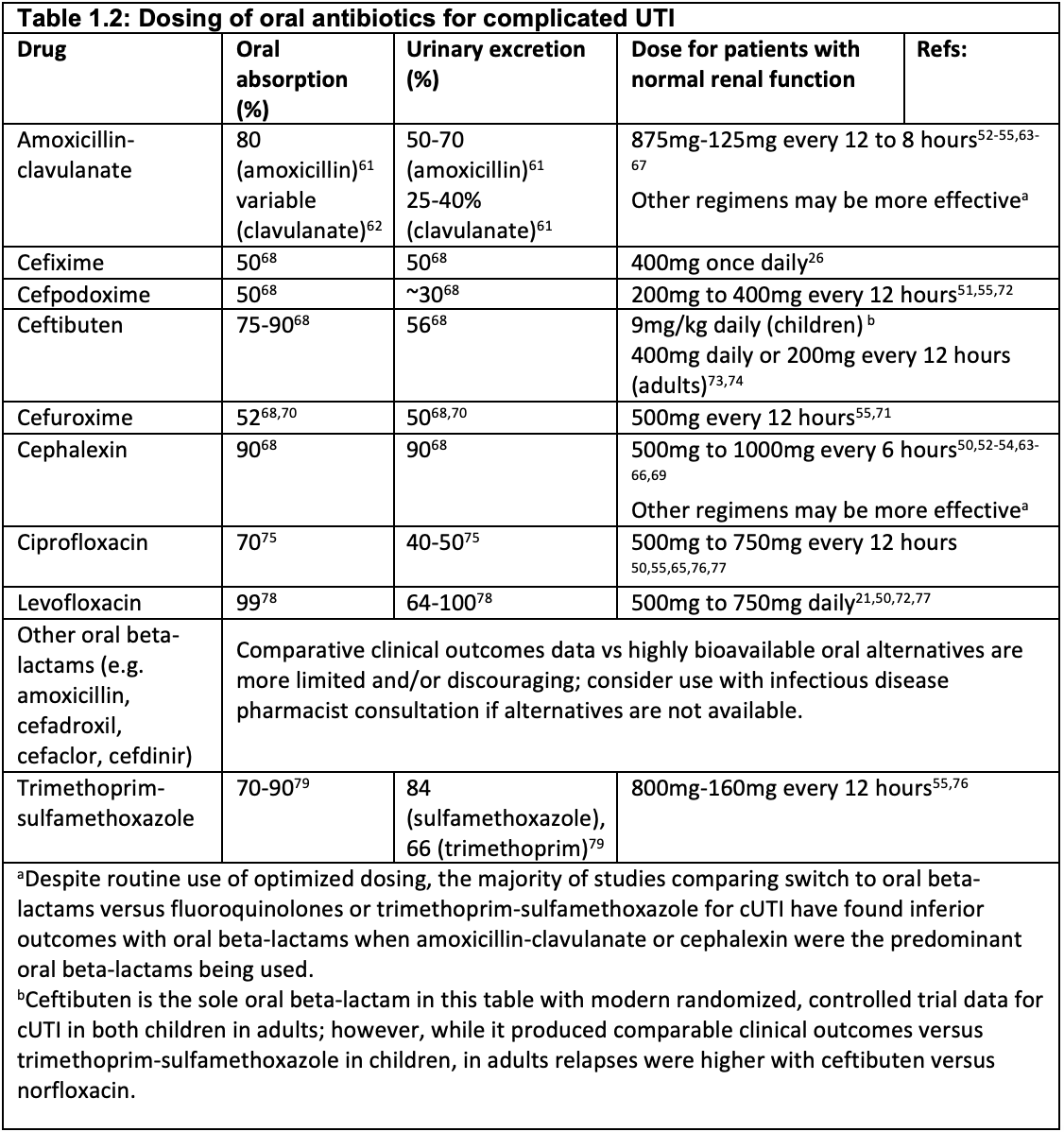
Approximate oral absorption and urinary excretion for common cUTI options
| Agent | Oral absorption | Urinary excretion |
|---|
| Amoxicillin-clavulanate | Amoxicillin about 80%; clavulanate variable | Amoxicillin 50–70%; clavulanate 25–40% |
| Cefixime | About 50% | About 50% |
| Cefpodoxime | About 50% | About 30% |
| Ceftibuten | 75–90% | About 56% |
| Cefuroxime | About 52% | About 50% |
| Cephalexin | About 90% | About 90% |
| Ciprofloxacin | About 70% | 40–50% |
| Levofloxacin | About 99% | 64–100% in the IDSA oral dosing table.45 |
| TMP-SMX | 70–90% | Sulfamethoxazole 84%; trimethoprim 66% |
These percentages describe absorption and urinary excretion. They do not establish adequate concentrations in blood or infected tissue. The regimen, organism MIC, renal function, and clinical evidence still determine whether a particular oral drug is suitable.2
Oral therapy for uncomplicated gram-negative bacteremia. When the source is controlled and the patient responds, susceptible fluoroquinolones or TMP-SMX are favored oral options. Host immune status affects whether the infection fits this uncomplicated category. Some oral beta-lactams can provide adequate exposure at optimized doses, but target attainment is uncertain with cefadroxil, cefpodoxime, and cefdinir. These distinctions reflect expert consensus and pharmacology; they do not come from a randomized comparison of oral agents.
38
Source control. Changing to oral therapy does not compensate for inadequate drainage, debridement, device management, or relief of obstruction. These are often the conditions that allow either oral or IV therapy to succeed.
Selected trials
A trial result is easiest to interpret by identifying who entered the study, what actually differed between the groups, and when the outcome was measured. Those details determine which clinical questions the study can answer.
MERINO
Randomized trial Harris et al., 2018. In 378 patients with ceftriaxone-resistant E. coli or K. pneumoniae bloodstream infection, 30-day mortality was 12.3% with piperacillin-tazobactam and 3.7% with meropenem. Piperacillin-tazobactam did not meet noninferiority. This helps explain the preference for carbapenems in ESBL bloodstream infection even when piperacillin-tazobactam tests susceptible. The trial itself did not study infection confined to other sites; guidance for those sites draws partly on extrapolation.17
CAMERA2
Randomized trial Tong et al., 2020. Adding 7 days of an antistaphylococcal beta-lactam to vancomycin or daptomycin for MRSA bacteremia did not improve the primary composite outcome. It reduced persistent bacteremia at day 5 but increased acute kidney injury from 6% to 23%, and the trial stopped early. This does not support routine combination therapy.8
OVIVA
Randomized noninferiority trial Li et al., 2019. Among 1,054 adults with bone, joint, or orthopedic hardware infection, an oral strategy used during the first 6 weeks was noninferior to continued IV therapy. Definite treatment failure within one year occurred in 67/509 (13.2%) in the oral group and 74/506 (14.6%) in the IV group among patients with endpoint data. The six-week period describes the assigned route strategy, not the failure follow-up window. OVIVA did not compare total treatment durations or establish equivalence for every oral drug. IV catheter complications were much more frequent with IV therapy. Oral drugs were selected by infection specialists. The trial excluded S. aureus bacteremia and bacterial endocarditis at presentation or within the preceding month; these results do not establish an oral strategy for those populations.9
POET
Randomized noninferiority trial Iversen et al., 2019. Four hundred stable adults with selected left-sided endocarditis due to streptococci, E. faecalis, S. aureus, or coagulase-negative staphylococci were randomized after at least 10 days of IV therapy. The composite outcome occurred in 9.0% with partial oral therapy and 12.1% with continued IV therapy. The conclusion applies to carefully selected, stable patients using protocolized combination regimens and close follow-up, not to routine early oral treatment of endocarditis.10
BALANCE
Randomized noninferiority trial Daneman et al., published online 2024 and in print 2025. In 3,608 hospitalized patients with bloodstream infection, 7 days was noninferior to 14 days for 90-day mortality. The trial excluded S. aureus, S. lugdunensis, fungemia, severe immunosuppression, prosthetic heart valves or endovascular grafts, and infections requiring prolonged therapy such as endocarditis, osteomyelitis, septic arthritis, undrained abscess, or retained infected prosthetic material. Seven days is not a universal bacteremia duration.11
Presenting the antibiotic plan on rounds
A useful presentation on rounds makes the reasoning audible: what infection explains the findings, what the antibiotic is expected to accomplish, and what new information would change the plan. The prompts below are a way to present that argument.
Syndrome and source
[What infection are we treating? Is the source controlled?]
Microbiology
[Relevant cultures, susceptibilities, and prior organisms]
Antibiotic decision today
[Drug and route] because [coverage, site, host, and resistance considerations]
Safety and dosing
[Renal/hepatic adjustment, allergy, interaction, and monitoring plan]
Reassessment
[What pending result or clinical change permits narrowing, oral transition, stopping, or additional source evaluation?]
Duration
[First day of effective therapy or other duration anchor, anticipated stop date, and reason]
Potential errors to examine
- Fever is treated as a diagnosis without establishing an infectious syndrome.
- Vancomycin and an antipseudomonal beta-lactam are continued after cultures and the clinical course allow narrowing.
- Vancomycin continues for MSSA without addressing whether an active antistaphylococcal beta-lactam is feasible.
- Susceptible Klebsiella is treated broadly because its narrower beta-lactam options were never reviewed.
- Fluoroquinolones are rejected categorically even when they provide the best susceptible oral option for cUTI or Pseudomonas.
- Renal function changes without a dosing reassessment, particularly with cefepime, vancomycin, aminoglycosides, TMP-SMX, or fluoroquinolones.
- A PICC is ordered before anyone asks whether a validated oral regimen is available.
- The drug is changed repeatedly while an abscess, obstruction, infected catheter, or hardware remains untreated.
Questions for the end of the session
1. A patient improves after urinary decompression. Blood and urine grow ceftriaxone-susceptible K. pneumoniae. What still justifies cefepime?
Answer
Neither the organism nor its stated susceptibility requires continued cefepime in this case. In the absence of another resistance concern, ceftriaxone is a narrower IV option. An oral option also requires the stability, obstruction relief, bloodstream exposure, intake, and safety checks described in the case; a susceptible result alone is insufficient.2
2. Which oral antibiotics can be relied on for susceptible Pseudomonas aeruginosa?
Answer
Ciprofloxacin and levofloxacin are the established oral options discussed here, provided the isolate is susceptible and the drug suits the site. Moxifloxacin is not a dependable substitute.16
3. What should be checked when monitoring vancomycin?
Answer
In serious MRSA infection, the useful measurement is exposure over 24 hours. A drug level is interpretable only in light of renal function, actual doses, and sample timing; a universal trough target does not answer that question.3
4. Does OVIVA show that every osteomyelitis patient can receive any active oral antibiotic from day 1?
Answer
No. Patients entered a specialist-directed oral strategy within 7 days of definitive surgery or planned curative treatment. Drug selection, source control, diagnosis, absorption, adherence, and follow-up still matter. OVIVA excluded S. aureus bacteremia or bacterial endocarditis at presentation or during the preceding month.9
5. What should happen when cultures narrow the likely pathogen?
Answer
The organism can narrow the differential, but the culture still needs a clinical explanation. If it fits the syndrome, a narrower effective drug may be appropriate, with route, source control, and duration reconsidered. If it represents colonization or contamination, there may be no infection to treat.
6. Fellow extension: An Enterobacterales isolate produces NDM. Is ceftazidime-avibactam alone a reliable choice?
Answer
No. Avibactam does not inhibit NDM, and NDM hydrolyzes ceftazidime. Aztreonam-avibactam and cefiderocol are preferred options for NDM-producing Enterobacterales. Ceftazidime-avibactam plus aztreonam is an alternative when the fixed aztreonam-avibactam product is unavailable. The isolate’s susceptibility, infection site, clinical stability, and source control distinguish among these specialist options.1
Antibiotic rounds sheet
Before the drug
Infection or mimic? Syndrome? Severity? Cultures? Prior organisms? Local resistance? Source control?
Coverage
Which likely organisms are covered? Which are missed? The susceptibility result is most useful when interpreted with the resistance mechanism, infection site, achievable exposure, and clinical evidence.1
Klebsiella
Ampicillin does not cover K. pneumoniae. Susceptible isolates may allow cefazolin, ceftriaxone, cefepime, pip-tazo, or carbapenem depending on syndrome and resistance mechanism. For invasive infection, use the systemic cefazolin breakpoint.43
Pseudomonas
Common IV options include cefepime, ceftazidime, piperacillin-tazobactam, meropenem, imipenem, aztreonam, or selected newer agents. Ciprofloxacin and levofloxacin are oral options only when the isolate is susceptible and the drug suits the site.16
Restricted agents
The resistance mechanism helps explain the choice: ceftazidime-avibactam for susceptible KPC or OXA-48-like Enterobacterales; ceftolozane-tazobactam for selected resistant Pseudomonas; aztreonam-avibactam or cefiderocol for susceptible NDM-producing Enterobacterales. Ceftazidime-avibactam plus aztreonam is an alternative if the fixed product is unavailable. Invasive CRAB is a separate problem, for which sulbactam-durlobactam is generally paired with imipenem-cilastatin or meropenem. Site and isolate testing still matter.1
Vancomycin
In serious MRSA infection, the usual AUC24 target is 400–600 mg·h/L when MIC is assumed to be 1 mg/L. Sampling time, renal function, and the dosing history determine what a level means.3
IV to oral
Can the oral drug cover this organism at the infected site? Stability, source control, absorption, adherence, and follow-up determine whether the evidence fits. Criteria for uncomplicated gram-negative bacteremia do not establish oral treatment for S. aureus bacteremia or endocarditis.38
Monitoring
Examples include timed levels and creatinine for vancomycin, CPK and renal function for daptomycin, weekly CBC for linezolid, and potassium, creatinine, and CBC for TMP-SMX. At discharge, a named clinician needs to receive and act on results.3252627 Cefepime-associated neurotoxicity calls for discontinuation and supportive care.42
A low PEN-FAST score does not clear a serious delayed reaction. Aztreonam and ceftazidime share an R1 side chain.421
Questions to close rounds
Why this drug and route? What reference supports the dose? Who follows toxicity and source control? What starts the treatment clock, and what would prompt a change before the planned stop date?
Local practice: the current antibiogram, formulary, renal replacement dosing resources, infusion protocols, microbiology reporting practices, and vancomycin and OPAT services supply details specific to the treating institution.
References
Guideline society recommendation. Randomized trial comparative trial evidence. Label or safety communication official regulatory source. Reviewed September 27, 2026.
- Guidance Tamma PD, Bonomo RA, Heil EL, Justo JA, Satlin MJ, Mathers AJ. IDSA 2026 Guidance on the Treatment of Antimicrobial-Resistant Gram-Negative Infections. Published July 30, 2026; evidence current through March 1, 2026. IDSA guidance.
- Guideline Trautner BW, Cortes-Penfield NW, Gupta K, et al. IDSA 2025 Guideline Update on Complicated Urinary Tract Infections. Published July 17, 2025. IDSA guideline.
- Consensus Rybak MJ, Le J, Lodise TP, et al. Therapeutic Monitoring of Vancomycin for Serious MRSA Infections. Am J Health Syst Pharm. 2020;77:835–864. Published March 19, 2020. doi:10.1093/ajhp/zxaa036. IDSA consensus page.
- Practice parameter Khan DA, Banerji A, Blumenthal KG, et al. Drug Allergy: A 2022 Practice Parameter Update. J Allergy Clin Immunol. 2022;150:1333–1393. Published December 2022. doi:10.1016/j.jaci.2022.08.028. Practice parameter.
- FDA safety U.S. Food and Drug Administration. Fluoroquinolone safety communications on disabling adverse effects, dysglycemia and mental health effects, and aortic aneurysm risk. Published 2016–2018. FDA information.
- Label CIPRO (ciprofloxacin) tablets and oral suspension, U.S. prescribing information. Adult UTI indications include susceptible K. pneumoniae and P. aeruginosa; dosage table revised September 2024. DailyMed label.
- Randomized trial Harris PNA, Tambyah PA, Lye DC, et al. Piperacillin-Tazobactam versus Meropenem for Ceftriaxone-Resistant E. coli or K. pneumoniae Bloodstream Infection. JAMA. 2018;320:984–994. Published September 11, 2018. doi:10.1001/jama.2018.12163. PubMed.
- Randomized trial Tong SYC, Lye DC, Yahav D, et al. Vancomycin or Daptomycin With versus Without an Antistaphylococcal Beta-Lactam for MRSA Bacteremia. JAMA. 2020;323:527–537. Published February 11, 2020. doi:10.1001/jama.2020.0103. PubMed.
- Randomized trial Li HK, Rombach I, Zambellas R, et al. Oral versus Intravenous Antibiotics for Bone and Joint Infection. N Engl J Med. 2019;380:425–436. Published January 31, 2019. doi:10.1056/NEJMoa1710926. PubMed; original protocol and eligibility criteria.
- Randomized trial Iversen K, Ihlemann N, Gill SU, et al. Partial Oral versus Intravenous Antibiotic Treatment of Endocarditis. N Engl J Med. 2019;380:415–424. Published August 28, 2018. doi:10.1056/NEJMoa1808312. PubMed.
- Randomized trial BALANCE Investigators. Antibiotic Treatment for 7 versus 14 Days in Patients with Bloodstream Infections. N Engl J Med. Published online November 20, 2024; print 2025;392:1065–1078. doi:10.1056/NEJMoa2404991. PubMed.
- Review Zdarska V, Arcari G, Kolar M, Mlynarcik P. Antibiotic Resistance in Klebsiella pneumoniae and Related Enterobacterales: Molecular Mechanisms, Mobile Elements, and Therapeutic Challenges. Antibiotics (Basel). 2026;15(1):37. Published January 1, 2026. doi:10.3390/antibiotics15010037. PubMed.
- Derivation and validation study Trubiano JA, Vogrin S, Chua KYL, et al. Development and Validation of a Penicillin Allergy Clinical Decision Rule. JAMA Intern Med. 2020;180(5):745-752. Published March 16, 2020. doi:10.1001/jamainternmed.2020.0403. PubMed.
- FDA label AVYCAZ (ceftazidime-avibactam) U.S. prescribing information. Initial U.S. approval 2015; label updated April 30, 2025. DailyMed label.
- FDA label ZERBAXA (ceftolozane-tazobactam) U.S. prescribing information. Initial U.S. approval 2014; label updated May 12, 2026. DailyMed label.
- FDA label FETROJA (cefiderocol) U.S. prescribing information. Initial U.S. approval 2019; label updated February 24, 2026. DailyMed label.
- FDA label EMBLAVEO (aztreonam-avibactam) U.S. prescribing information. Initial U.S. approval 2025; label revised June 2026. DailyMed label.
- FDA approval U.S. Food and Drug Administration. FDA Approves First Oral Carbapenem Therapy for Complicated Urinary Tract Infections. Published June 17, 2026. FDA announcement.
- FDA approval U.S. Food and Drug Administration. FDA Approves New Treatment for Uncomplicated Urinary Tract Infections in Adult Women Who Have Limited or No Alternative Oral Antibiotic Treatment Options. Published October 24, 2024. FDA announcement.
- Pipeline status and in vitro evidence Basilea Pharmaceutica. Ceftibuten-ledaborbactam development update, October 27, 2026. Developer announcement. Karlowsky JA, Wise MG, Hackel MA, Pevear DC, Moeck G, Sahm DF. Ceftibuten-Ledaborbactam Activity against Multidrug-Resistant and Extended-Spectrum-Beta-Lactamase-Positive Clinical Isolates of Enterobacterales from a 2018-2020 Global Surveillance Collection. Antimicrob Agents Chemother. 2022;66:e00934-22. Published October 26, 2022. doi:10.1128/aac.00934-22. Original study.
- Prospective allergy study Romano A, Gaeta F, Valluzzi RL, et al. IgE-mediated hypersensitivity to cephalosporins: cross-reactivity and tolerability of penicillins, monobactams, and carbapenems. J Allergy Clin Immunol. 2010;126:994–999. Published November 2010. doi:10.1016/j.jaci.2010.06.052. PubMed.
- FDA label TEFLARO (ceftaroline fosamil) U.S. prescribing information. Initial U.S. approval 2010; current label reviewed September 14, 2026. DailyMed label.
- FDA label ZEVTERA (ceftobiprole medocaril sodium) U.S. prescribing information. Initial U.S. approval 2024. DailyMed version 7, effective October 13, 2026. Sections 1.1–1.3 and 5.1. DailyMed label.
- Randomized noninferiority trial Holland TL, Cosgrove SE, Doernberg SB, et al. Ceftobiprole for Treatment of Complicated Staphylococcus aureus Bacteremia. N Engl J Med. 2023;389:1390–1401. Published online September 27, 2023. doi:10.1056/NEJMoa2300220. PubMed.
- FDA label CUBICIN RF (daptomycin) U.S. prescribing information. Label updated March 17, 2025; reviewed September 14, 2026. DailyMed label.
- FDA label Linezolid U.S. prescribing information. Label revised June 2026; reviewed September 14, 2026. DailyMed label.
- FDA label BACTRIM DS (trimethoprim-sulfamethoxazole), Sun Pharmaceutical U.S. prescribing information. DailyMed label.
- FDA label Metronidazole tablets U.S. prescribing information; reviewed September 14, 2026. DailyMed label.
- FDA label MACROBID (nitrofurantoin monohydrate/macrocrystals), U.S. prescribing information. DailyMed label.
- FDA label DIFLUCAN (fluconazole tablets and oral suspension), Pfizer U.S. prescribing information. DailyMed label.
- Retrospective comparative study Turner RB, Wilson DE, Saedi-Kwon H, et al. Comparative analysis of neutropenia in patients receiving prolonged treatment with ceftaroline. J Antimicrob Chemother. 2018;73:772–778. Published online December 8, 2017. doi:10.1093/jac/dkx452. PubMed.
- FDA label VABOMERE (meropenem-vaborbactam) U.S. prescribing information; reviewed September 14, 2026. DailyMed label.
- FDA label RECARBRIO (imipenem-cilastatin-relebactam) U.S. prescribing information; reviewed September 14, 2026. DailyMed label.
- FDA label XACDURO (sulbactam-durlobactam) U.S. prescribing information; reviewed September 14, 2026. DailyMed label.
- Review Chaudhry SB, Veve MP, Wagner JL. Cephalosporins: A Focus on Side Chains and Beta-Lactam Cross-Reactivity. Pharmacy (Basel). 2019;7(3):103. Published July 29, 2019. doi:10.3390/pharmacy7030103. PubMed.
- Randomized noninferiority trial Seo JW, Kim DY, Yoon Y, et al. Fosfomycin as Oral Transition Therapy Versus Continued Intravenous β-Lactams for Complicated Urinary Tract Infections Caused by Extended-Spectrum β-Lactamase–Producing Enterobacterales: A Multicenter, Open-Label, Randomized Controlled Trial. Clin Infect Dis. 2026;83:364–372. doi:10.1093/cid/ciag345. PubMed.
- Consensus guidance Heil EL, Bork JT, Abbo LM, et al. Optimizing the Management of Uncomplicated Gram-Negative Bloodstream Infections: Consensus Guidance Using a Modified Delphi Process. Open Forum Infect Dis. 2021;8(10):ofab434. Published October 11, 2021. doi:10.1093/ofid/ofab434. Open-access article.
- Consensus statement and systematic review Nelson Z, Aslan AT, Beahm NP, et al. Guidelines for the Prevention, Diagnosis, and Management of Urinary Tract Infections in Pediatrics and Adults: A WikiGuidelines Group Consensus Statement. JAMA Netw Open. 2024;7(11):e2444495. Published November 4, 2024. doi:10.1001/jamanetworkopen.2024.44495. PubMed.
- FDA label Fosfomycin tromethamine granules for oral solution, U.S. prescribing information. Current label reviewed September 14, 2026. DailyMed label.
- Institutional clinical tool Northwestern Medicine Antimicrobial Stewardship Program. Beta-Lactam Cross-Reactivity Side-Chain Chart. Accessed September 27, 2026. Northwestern Medicine chart.
- FDA label Cefepime injection, U.S. prescribing information, section 5.2. FDA label.
- Breakpoint references FDA systemic cefazolin breakpoints. CLSI AST News Update, 2026, Scenario 2.
- Manufacturer announcement GSK. Tebipenem pivoxil U.S. approval and planned availability. June 17, 2026. GSK announcement.
- Guideline table IDSA 2025 guideline on management and treatment of complicated urinary tract infections: selection of antibiotic therapy. IDSA Table 1.2, oral dosing and urinary excretion.